Posts

Image
  Basic Bacterial Morphology  Bacteria and fungus (mold and yeast) grow in a variety of shapes, sizes and colors.  Although it is difficult to make a definite identification of cultures growing in broth or solid media many have distinguishing characteristics that give us clues to identification.  Many Microbiologist can make a tentative identifications by growth characteristics but definitive id requires further testing (ie Gram stain, chemical testing, etc). The palm of a hand print print done on TSA agar.  There is a mix of different textured and colored colonies on the plate some bacterial some yeast.  By looking at color, texture, growth times and various growth temperatures you can get an idea as to what is on the plate.  Ex:  the orange colonies are yeast and tend to grow better at room temperature or refrigerated temperatures where the large colony on the left ( Bacillus spp) and the white colonies ( Staphylococcus ) grows wel...
Image
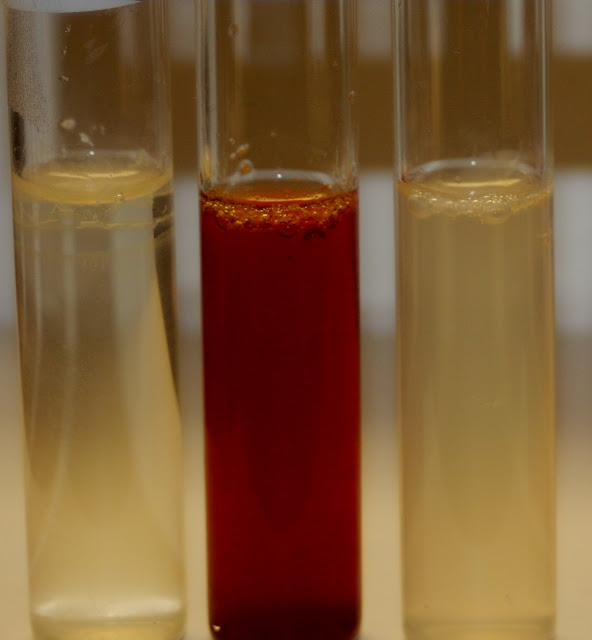
Nitrate Reduction/Nitrate Reductase Test Some bacterial species are able to reduce nitrate (NO3)  to nitrite (NO2)  using the enzyme nitrate reductase in an anaerobic process by using molecules other then oxygen, nitrate, as a terminal electron acceptor.  To determine if a bacteria is able to reduce nitrate they are grown in a nitrate broth and a series of chemical are added to detect nitrate reduction. (A)                                                 (B)                                                     (C)      Nitrate reduction test for the reduction of nitrate in nitrate media, to determine if the bacteria contains nitrate and/or nitrite reductase. Organism were incubated for 48 hr's at...
Image
  Streptococcus Identification Identification  of  Streptococcus spp  can cause a range of infections from throat infections, toxic shock an a number of other skin and organ infections that can be  mild to deadly. So it is important to be able to identify and differentitate between the different  Streptococcus spp  for treatment.     After a sample has been isolate and a culture grown a Gram Stain is preformed. Gram stains are the first test performed and  Gram reaction and cell morphology dictates the next test performed.   Streptococcus spp  are Gram (+) and have a rope/chain like appearance.   S. pyogenes (causes Strep throat).  The coccuc/ovoid Gram (+) shaped cells form long distinctive chains ("strepto" greek for twisted chain).  Once the Gram stain is done and Gram (+) coccus are seen then the catalase test is done to differentiate between Staphylococcus and Streptococcus (...